AI Literacy · Workshop №3 · Masterclass
When Computational Thinking Slows You Down
A 90-minute masterclass on the kinds of slowness that pay off.
AI Literacy Masterclass №1 · Led by Nitzan Hermon · Index Greenpoint · CBS, 2026
Welcome
Where have you noticed AI making something flatter than you wanted?
Jot it down. No need to share.
Cortada's ladder
Data, information, knowledge, wisdom. James Cortada, historian of information, has spent decades on this distinction.
| Level | What it is |
|---|---|
| Data | Bits, numbers, letters |
| Information | How they relate |
| Knowledge | What it means for the present, based on the past |
| Wisdom | What it means for the future |
Common- denominator thinking
AI is a very large spreadsheet with fixed correlations that average toward the middle.
It is useful for drafting, summarizing, and getting unstuck.
But Wisdom lives in the particular, not the average.
Where in your work does the trade-off actually matter, and where doesn't it?
Bisociation
Arthur Koestler (1905—1983), Hungarian-British writer and polymath, introduced bisociation in his 1964 study of creativity, The Act of Creation.
Two ways of thinking that don't normally meet suddenly intersect at one point.
The mind holds both contexts at once. That double-perception is the creative event.
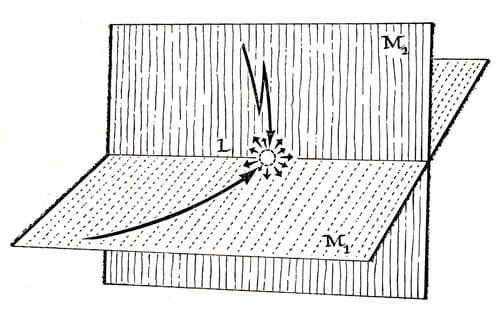
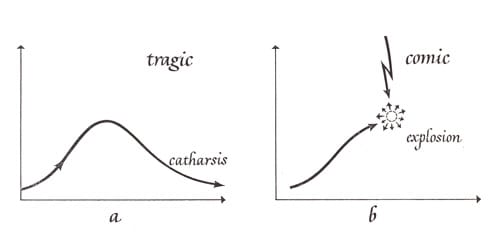
Bisociation is not association. It is not synthesis.
Association links things within one matrix, on the same plane of thought. Bisociation crosses planes.
Synthesis is a planned combination of known parts. Both association and synthesis sit between information and knowledge.
Bisociation is the unexpected meeting of two planes that, until that moment, didn't know each other existed.
Bisociation is the only creativity that can become wisdom.
Holarchy
A hierarchy of part-wholes.
Every unit in nature, language, and mind is two things at once: a whole to what it contains, a part of what contains it.
Koestler called the unit a holon: from holos (whole) + on (particle).
The holarchy that contains you
Creation has a specific address, you are a ring inside it.
Person→Kin→Society→Culture
Each ring contains what's inside it, and is contained by what is outside it.
After Charles & Ray Eames, Powers of Ten, 1977.
Embodied creativity
The self is the only unit capable of holding two incompatible ways of being at once.
Machines can only operate within tidy spreadsheets; it is only humans that can connect with frictionful creativity — the kind that leads to wisdom and bisociation.
Cells can't bisociate.
Levels of Specificity
Type your name and answer "what do you do for a living?" in the outer ring. Keep going deeper, ring by ring. Five or six rings minimum.
Value
VALUE = UTILITY + AESTHETICS
Knowing when to shift from the specific (leadership and self-actualization) to the general (utilitarian and tactical) helps us to economically articulate what we do in a changing world.
Discuss your answer in pairs
- Which of the rings feels most like you?
- What part of this diagram feels more or less creative?
- What feels like the future or the past?
- Which part of this asks for knowledge, and which for wisdom?
- Where is bisociation required? What can AI do?
The Thread
AI literacy is learning which rung you're standing on — and protecting the top of the ladder in your own work.
Thank you
The full AI Literacy course goes deeper.
What you paid today will go towards the full course (which is month-to-month). I will be around if you have questions.
Reflect
Take a minute to reflect on what you wrote at the beginning of the evening.
Bring this workshop to your team.
Ninety minutes, on-site or remote. Each workshop stands alone; together they build a literacy your team shares.
- Where AI is powerful. Where it falls apart. And the difference your judgment makes.
- AI is fluent. It sounds like it understands. Fluency and understanding are not the same thing.
- A 90-minute masterclass on the kinds of slowness that pay off.
Bring it in-house
Run this masterclass
for your team.
The full session goes deeper than this page — Koestler's bisociation, the holarchy of self and culture, embodied creativity, and a live drawing exercise participants take into their own work the next morning.
Most teams using AI have learned to move faster. Fewer have learned where speed is making their work flatter — and what to do about it. This 90-minute session gives your team shared vocabulary for both.
What your team leaves with
- A working metaphor for what AI is and isn't — Cortada's ladder applied to their own work
- Koestler's bisociation as a definition of creativity AI cannot satisfy by design
- The Levels of Specificity exercise, repeatable on any project or prompt
- Four prompting moves that build clarity instead of collapsing it
- A printed or exported artifact each participant takes home, plus a follow-up reading list
Formats
In-person · NYC
90 minutes
Up to 20 people. Your office or Index Greenpoint. Includes materials.
Remote
90 minutes
Zoom, up to 30 people. Same exercise, asynchronous follow-up.
Quarterly retainer
Series of four
Themed sessions across a quarter. Best for teams adopting AI in production.
Nitzan replies with a proposal within two business days.

Your instructor
Nitzan Hermon
Coach, writer, and educator. Founder of Critical Business School, a meta-disciplinary design school in Greenpoint, New York City.
Nitzan's work sits at the intersection of creative practice and business — helping individuals and organizations articulate what they actually do, what they're for, and what to build next. He has spent years translating between technologists and the people who have to live with what they build, and has been paying close attention to what AI is changing about how creative people work.
He writes Being in Space, a newsletter on creative surplus.
Produced by Critical Business SchoolInquiries info@criticalbusinessschool.com