Prediction, Ambiguity, and the Limits of Machines
Notes from AI Literacy Salon #1 – March 26, 2026
Most conversations about AI start with what it can do. This one started with what it actually is.
At the first AI Literacy Salon, hosted by In Process Coaching and joined by guests Noa Dolberg (Google’s Material Design), Cherae Robinson (Head of Platform, Flybridge), and Sam Spurlin (Founder, Deliberate Works), we spent an evening thinking together about a question that doesn’t get asked enough: when does AI help, and when does it just look like it’s helping?
The salon was built for creative professionals – not because they need to become technologists, but because AI is reshaping the terrain they walk on. The goal wasn’t to teach prompts or tools. It was to build a way of thinking about what AI does well, where it falls apart, and why that distinction matters for anyone doing creative work.
The prediction engine
Here’s the starting point: almost everything AI does comes back to one word – prediction.
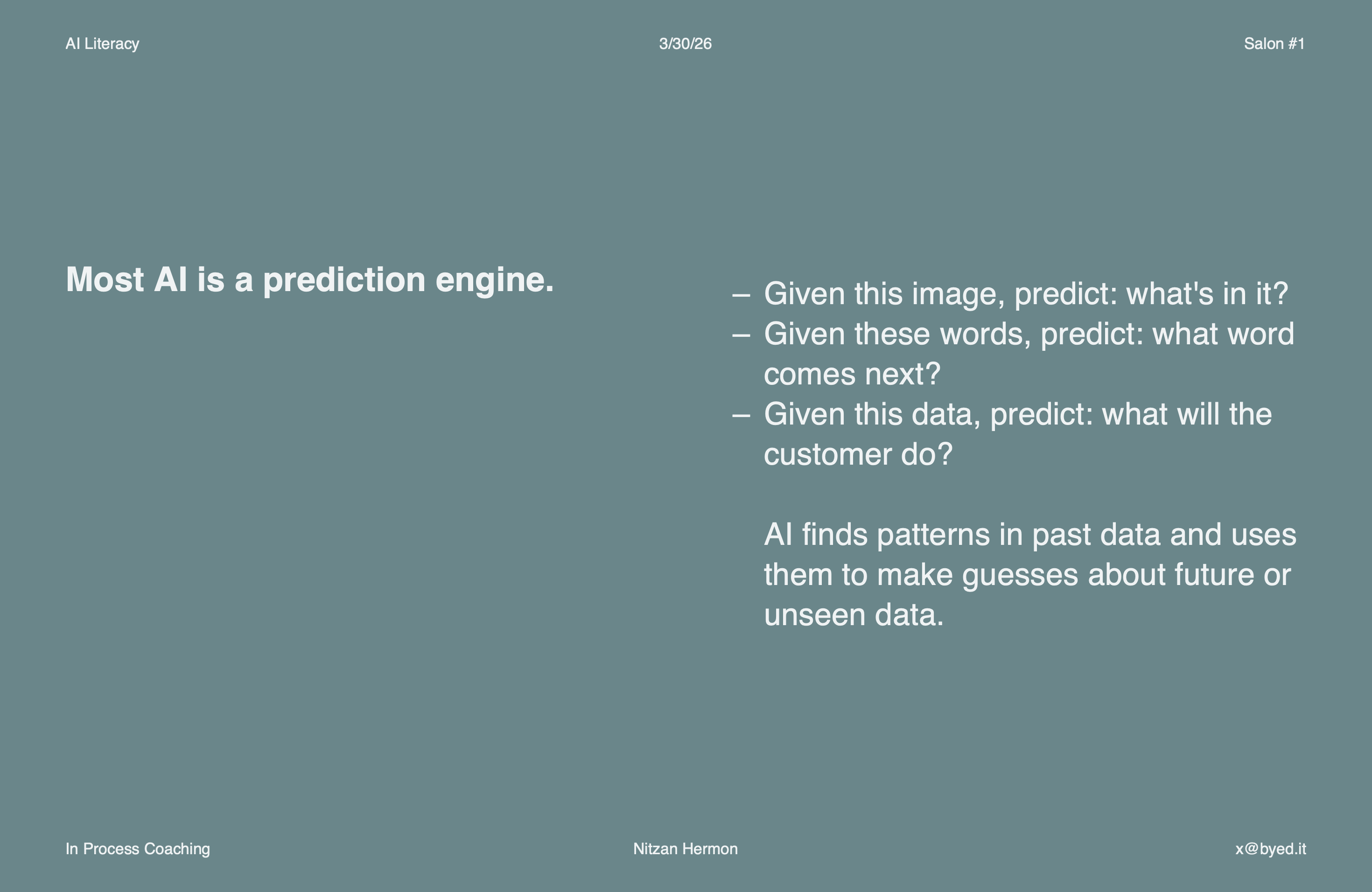
Given an image, predict what’s in it. Given a string of words, predict what comes next. Given a customer’s behavior, predict what they’ll do. AI finds patterns in past data and uses them to make guesses about future or unseen data. That’s the engine under the hood, whether you’re talking about medical imaging, language translation, recommendation algorithms, or code generation.
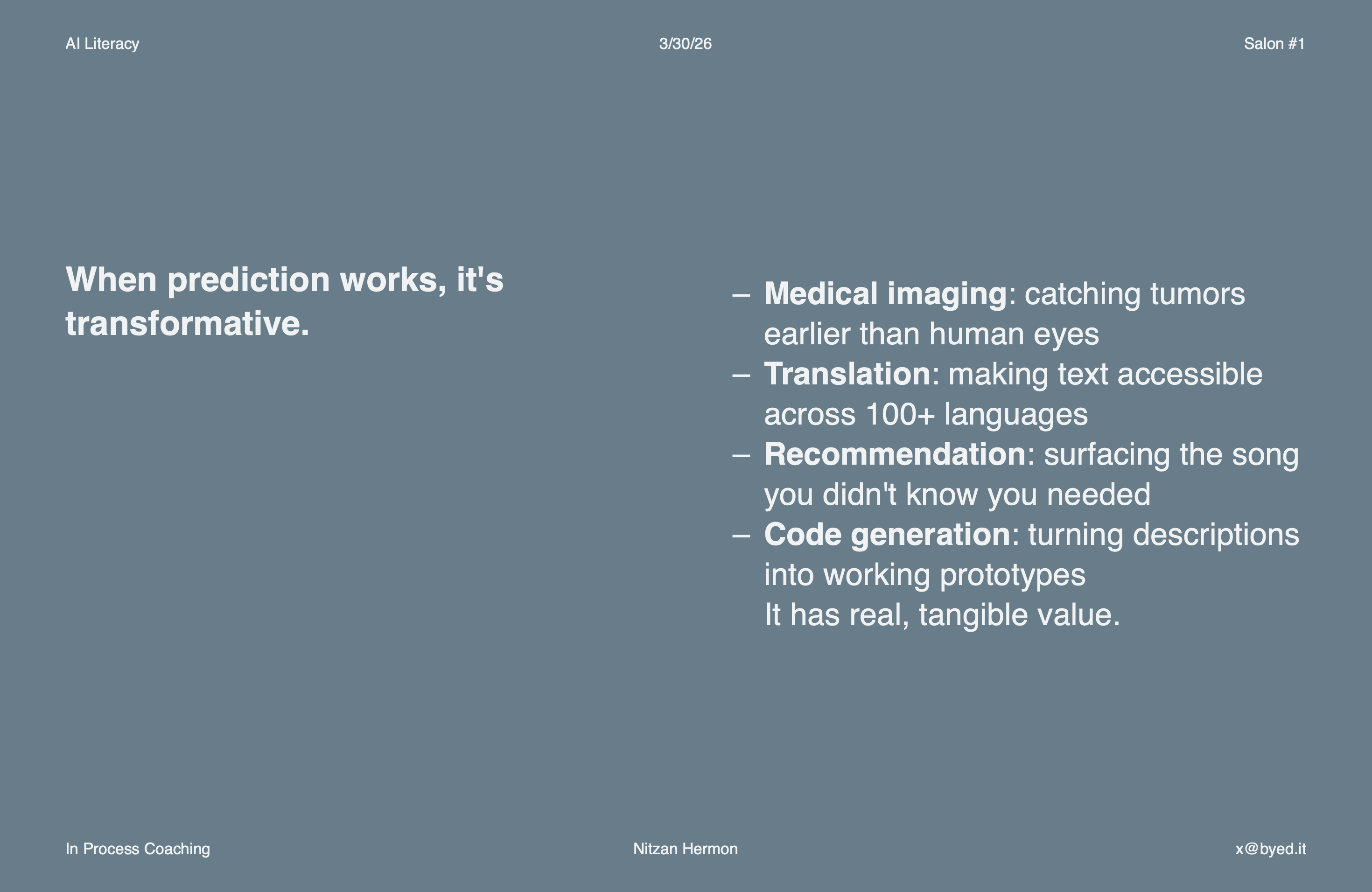
And when predictions work, they're transformative. It catches tumors earlier than human eyes. It makes text accessible in more than 100 languages. It surfaces the song you didn’t know you needed. It turns descriptions into working prototypes. There is real, tangible value here.
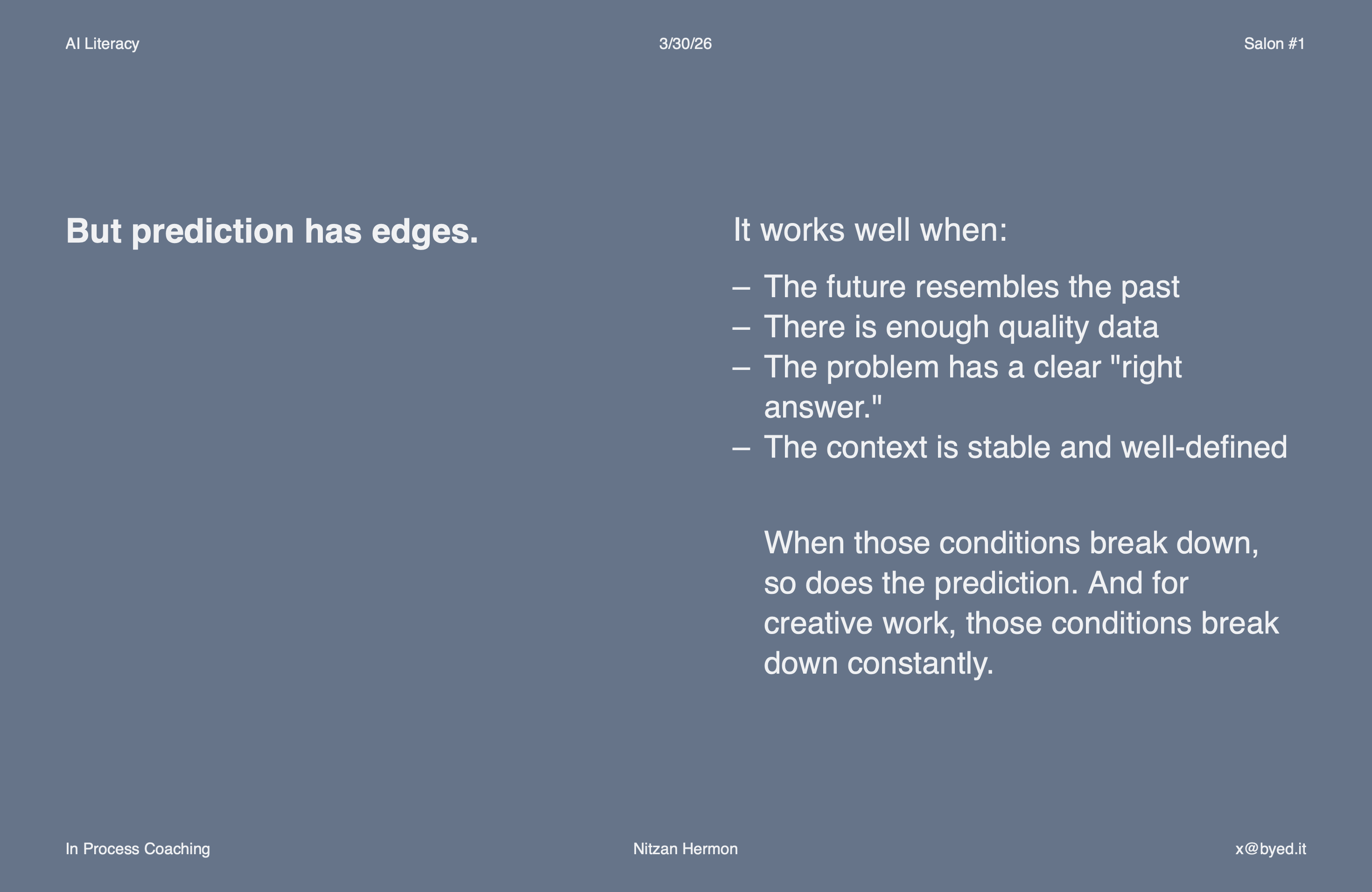
But prediction has edges. It works well when the future resembles the past, when there’s enough quality data, when the problem has a clear “right answer,” and when the context is stable and well-defined. When those conditions break down, so does the prediction. And for creative work, those conditions break down constantly.
The ambiguity problem
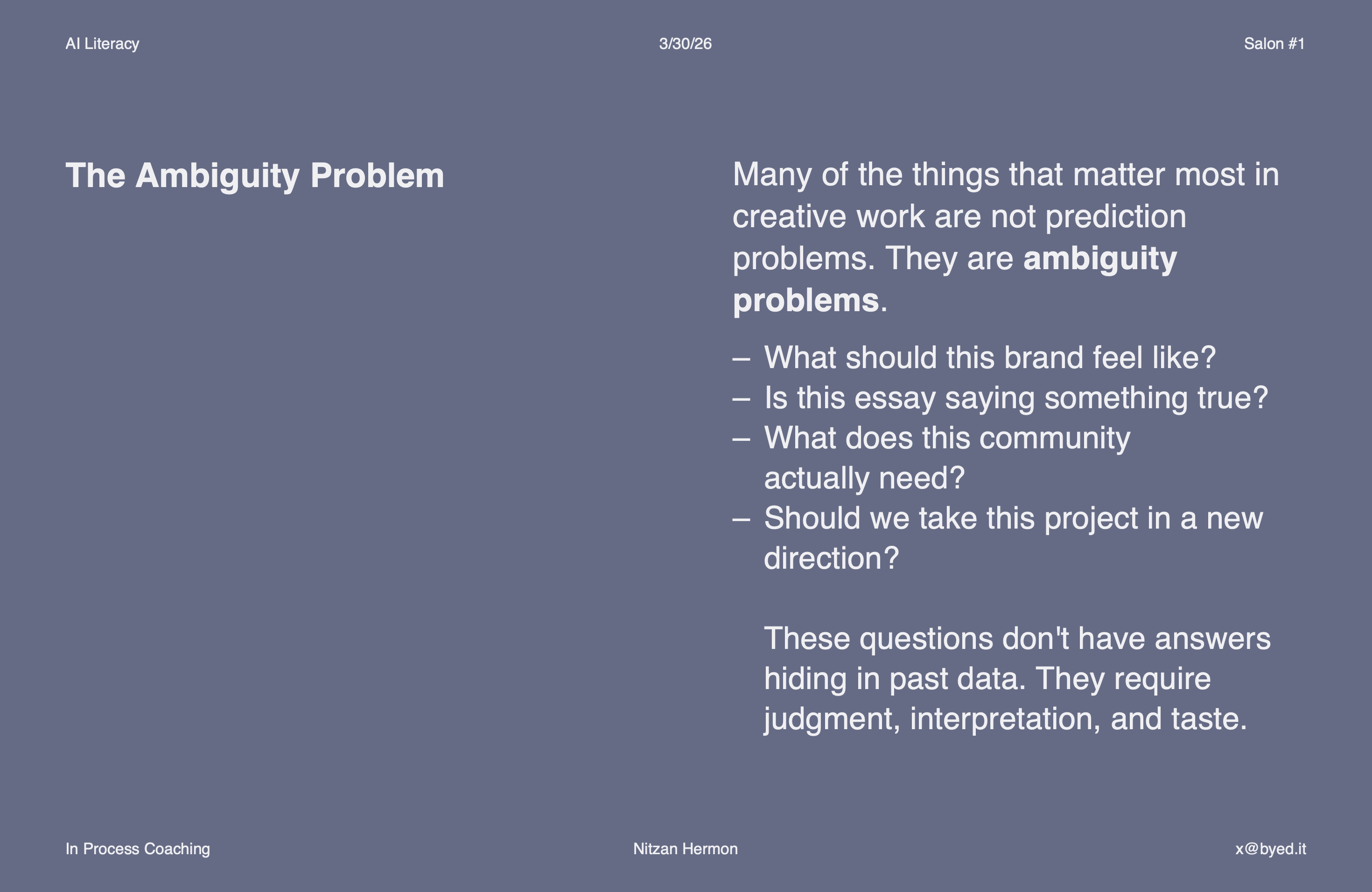
This is where the salon got interesting. Many of the things that matter most in creative work are not prediction problems. They are ambiguity problems.
What should this brand feel like? Is this essay saying something true? What does this community actually need? Should we take this project in a new direction? These questions don’t have answers hiding in past data. They require judgment, interpretation, and taste.
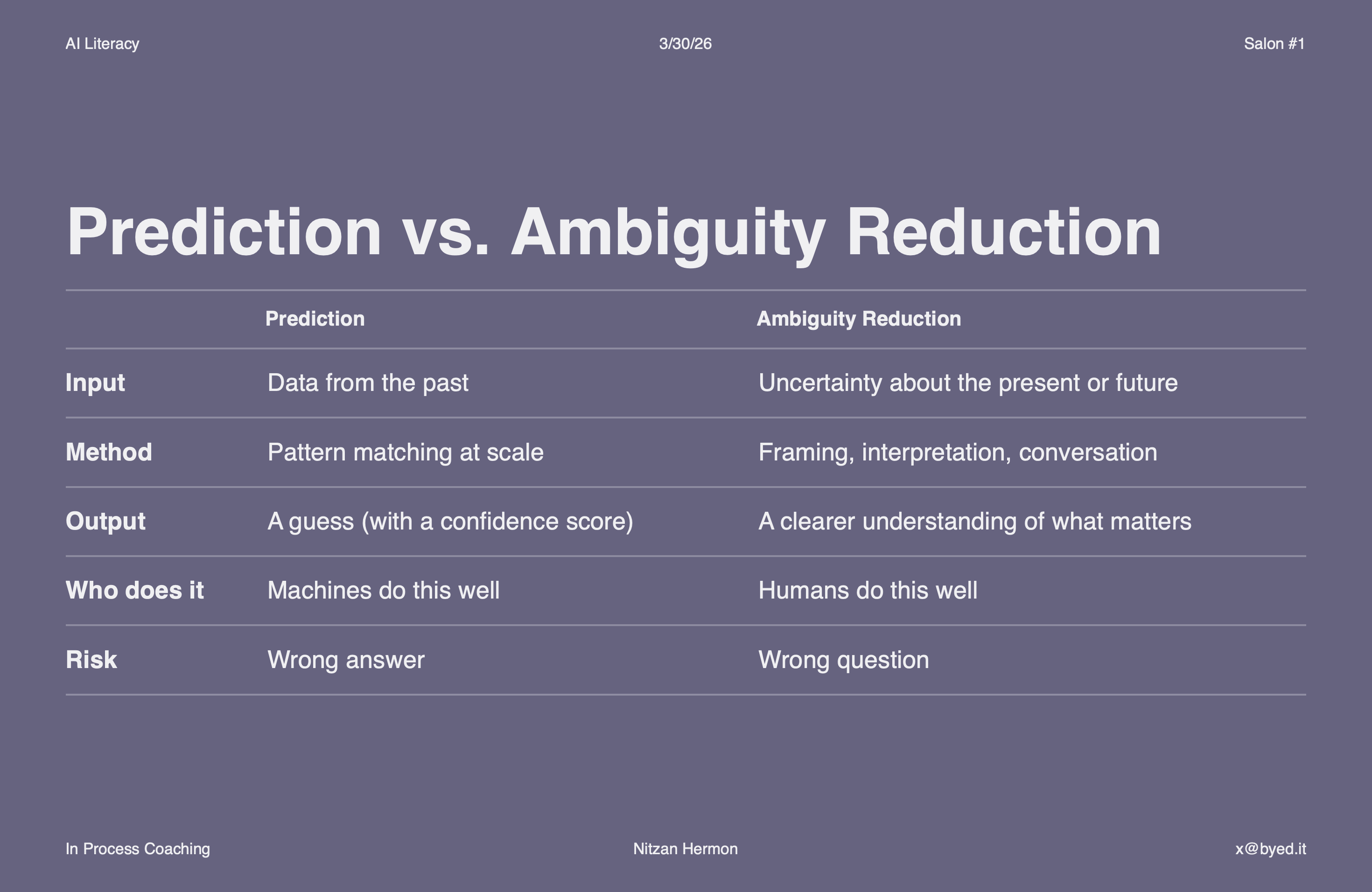
Prediction asks: given what has happened, what will happen next? Ambiguity reduction asks: what is actually going on, and what should we do about it?
AI is exceptional at the first. It is, at best, a thinking partner for the second. Knowing which one you’re facing – that’s the skill.
This is also where creatives tend to get tripped up. “AI will replace designers” assumes design is prediction. “AI will write your strategy” assumes strategy is prediction. The hype cycle collapses prediction and ambiguity reduction into a single concept. But some parts of creative work are prediction-like – layout suggestions, copy variants, image generation. The parts that aren’t? That’s where your value lives.